
Introducing BoardGameUniverse.com: Free Multiplayer Board Games in Your Browser
Announcing BoardGameUniverse.com — Play free multiplayer board games online. No downloads. No signup. Just launch!
Announcing BoardGameUniverse.com — Play free multiplayer board games online. No downloads. No signup. Just launch!
Record, edit, loop, and sleep to your own sounds. Today we’re excited to announce the all-new White Noise Recorder — a brand-new release for Android and a complete rewrite for iOS. Best of all, it’s free on both platforms. White Noise Recorder makes it easy to capture the sounds that help you sleep: a fan, an air conditioner, rain on the window, … Read more
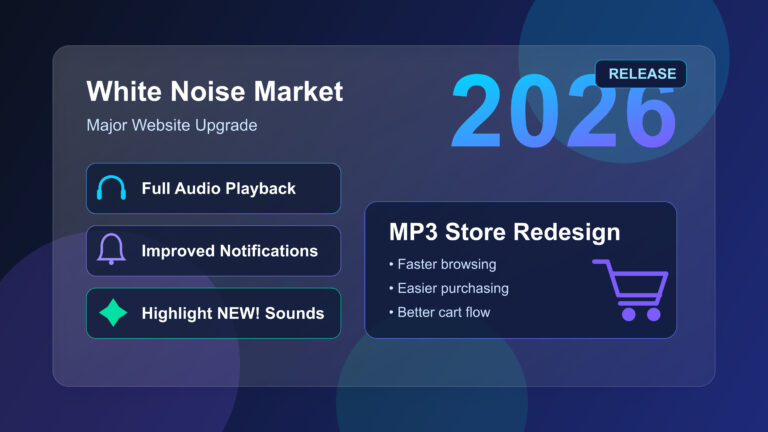
We’ve made a series of meaningful updates to the White Noise Market website focused on three big goals: allowing full playback of audio sounds via website, highlighting new sounds for quicker discovery, and MP3 store improvements. One of the biggest improvements is full looping audio playback for our subscribers. We’ve improved the browser audio experience … Read more

White Noise Market, a leading social platform for ambient sound enthusiasts, is thrilled to release a significant update to it’s platform, enhancing user interaction and personalization. This update marks a pivotal step towards creating a more intuitive, engaging, and personalized experience for users seeking the perfect white noise or ambient sound. Let’s dive into the … Read more
The White Noise MP3 Store Catalog that allows purchasing of our most popular sounds as MP3 files just received a major update. We’ve added 10 more sounds to the catalog and the user interface was completely redesigned and simplified. You’ll notice there are 3 tabs: Catalog, Cart & Checkout, and Orders & Downloads. The catalog … Read more

The White Noise Market is getting a MAJOR overhaul that requires all users to upgrade to the latest versions of the iOS App and Android App. White Noise Market Apps that are not upgraded to at least 9.0 will no longer work in the coming weeks. This is because we are changing our cloud provider … Read more

TMSOFT’s White Noise Sleep Sounds has published our latest album, Sleep Music, to all major streaming platforms including Spotify, Apple Music, Amazon Music, YouTube Music, and more! Sleep Music features a collection of twelve meticulously crafted tracks, each with the purpose of lulling you into sleep and ensuring you stay asleep without disturbances. With the … Read more

White Noise 8 has been released for Android and iOS and it continues to evolve based on user feedback. We have added exciting new features, including the innovative Sleep Log, which allows you to track your sound playtime and help you understand your sleep patterns. Let’s dive in! Sleep Log The Sleep Log is now … Read more
Although our Generator apps has been out for some time, almost five years to be exact, we thought we’d share the inside scoop on how to get the most out of the Tone Generator app and some recent updates we’ve made. In the Tone Generator app, the sound of the tone is determined by the … Read more
In general white noise is used as a general term to refer to rushing sounds like radio static, river rapids, or heavy water flow from a sink. This type of sound is created by many random frequencies played in rapid succession.